
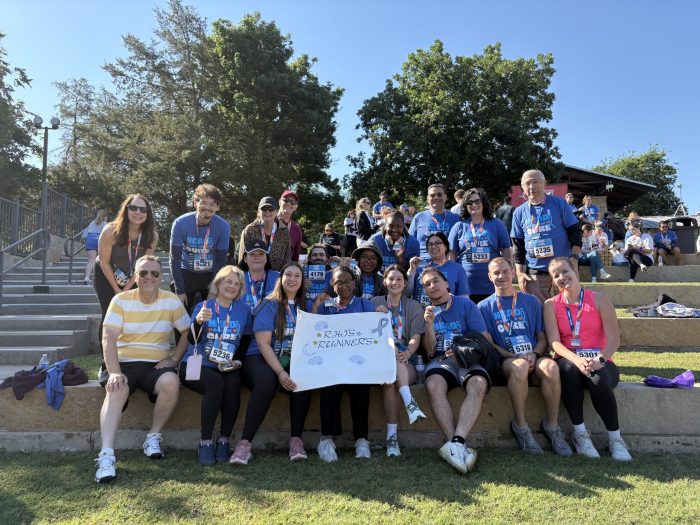
Your 20s are supposed to be full of learning, laughter, love, and figuring out what comes next. For 25-year-old Rhiannon, all of that changed in an instant. After graduating from Baylor, she began her nursing career, excited to pursue her passion for helping people and to travel the world. She had a future she was looking forward to, never imagining that she would soon find herself navigating a diagnosis that would change nearly every part of her life.
In August 2025, she became the patient after visiting the ER twice for right-sided facial numbness and severe vertigo. She was misdiagnosed with a migraine and told she had Bell’s palsy. At the first visit, a CT scan was done, and the tumor was present, but it was read incorrectly, and she was sent home.
In early September, Rhiannon returned to the ER a third time for vertigo, vomiting, and right-sided facial numbness, and had another CT scan. This time, she received the news no one ever wants to hear and was admitted for a brain mass. After talking with her family, she made the difficult decision to transfer to UT Southwestern in hopes of receiving the specialized care she needed.
Further testing confirmed what she and her family feared, and she was diagnosed with a diffuse midline glioma (DMG). DMGs are most common in children between the ages of 5 and 10, though they can affect adults too. They typically arise in the deep, midline area of the brain and can affect the thalamus, brainstem, and spinal cord.
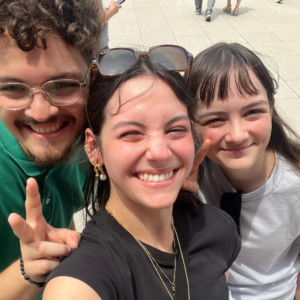
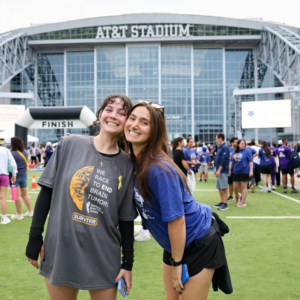
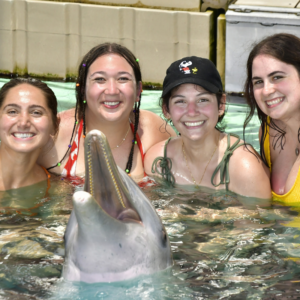
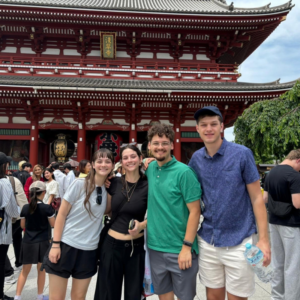
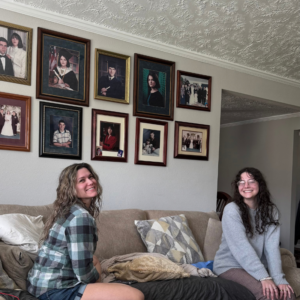
For Rhiannon, the diagnosis brought more than physical challenges. It changed the life she had been building and forced her to step away from the career she loved. She had to quit working and stop driving, losing pieces of her independence that many young adults take for granted. The diagnosis also changed the way she looks at the future. “I go day by day as my prognosis isn’t the best and life could change in an instant; I learned that the hard way.”
There are also difficult moments that come with feeling like your independence has been taken away. Rhiannon described how hard it can be to keep pushing forward, especially when it feels like “you become a kid again, and we don’t want to be seen as ‘sick’ or ‘helpless.’” At an age when she should be building her career, making plans, and experiencing new things, she is instead learning how to navigate a life she never expected to have.
Her diagnosis has also changed some of her relationships. When asked how she navigated relationship changes, Rhiannon shared, “I broke up with my boyfriend of 6 months because he completely stopped responding to me. I’m assuming it was because my diagnosis was too much for him to handle. My friendships have really grown with my close friends, but you do have some people who kind of disappear and don’t reach out.”
For young adults facing a brain tumor diagnosis, those relationship changes can add another layer of loneliness to an already overwhelming experience. The adolescent and young adult (AYA) brain tumor community often has fewer resources due to the wide age range of 15 to 39 and the very different stages of life within that group. Finding people who truly understand what it means to face a life-changing diagnosis so young can be incredibly difficult.
Rhiannon is determined to use her experience to support other young adults facing a similar journey. Now an Ambassador for Head for the Cure and more involved with local AYA survivors, she wants others to know, “I truly do understand what they are going through and how hard it is. I would also tell them they might want to give up and think, ‘what’s the point?’ But there are so many people who want the best for you and who are rooting for you. And you’ll hear ‘be positive’ and ‘keep a positive mindset,’ but it’s totally okay to not smile all the time, because it sucks.”
Her honesty is a reminder that hope doesn’t always look like positivity. Sometimes, hope is simply continuing to show up, finding people who understand, and taking things one day at a time.
Despite the hard times and the challenge of managing her “new normal,” Rhiannon still has hope for what’s ahead. She is excited about new research and a treatment recently approved for her tumor type, and she finds encouragement in the people who continue to show up for the brain tumor community. “Seeing how many people care and show up for the races gives me hope for the future.”
For someone whose plans changed so suddenly, that hope means something powerful. Rhiannon may not know exactly what tomorrow will bring, but she is making sure she doesn’t have to face it alone. Through her own experience, she is helping other young adults feel a little less alone, too.